
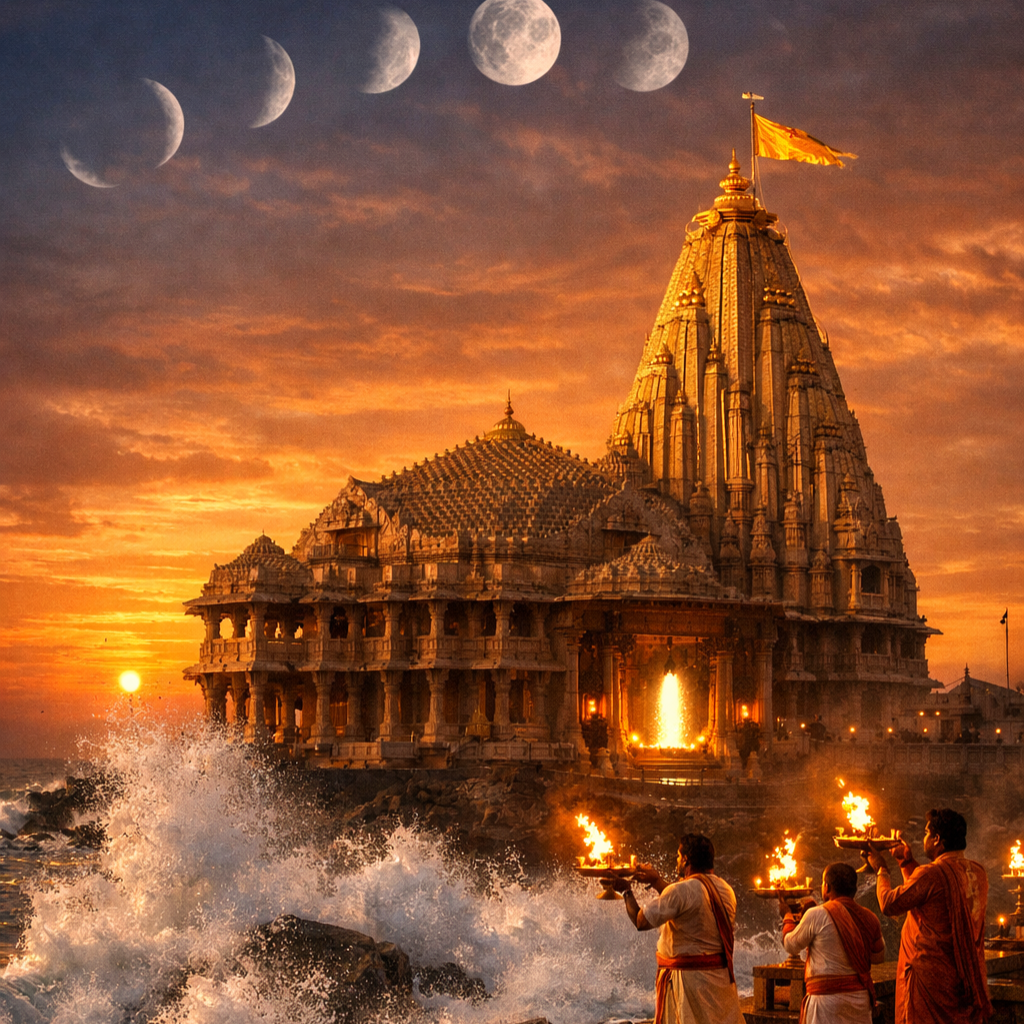

Stand on the western edge of India at dusk, where the land meets the vast Arabian Sea. Waves crash endlessly against the shore, and the wind carries the scent of salt and incense together. Rising above this restless horizon stands the temple of Somnath Temple - a shrine whose story is unlike almost any other sacred place on earth. For more than a thousand years, Somnath has faced destruction, invasion, and rebuilding. Armies attacked it. Empires plundered it. Yet every time it fell, devotees returned and rebuilt it again with the same devotion. Because of this relentless cycle of destruction and revival, Somnath is often described as the eternal shrine of resilience.
But history alone does not explain why this temple matters. Why is Somnath regarded as the first among the twelve Jyotirlingas of Shiva? Why did merchants sailing between distant continents stop here centuries ago? And why is this shrine known as the temple of the Moon? To understand that mystery, we must leave the world of history and enter a much older memory - one preserved in the sacred narratives of the Purāṇas.
Moon has lost its charm according to Myths.
Raja Daksh Prajapati had twenty-seven daughters and each represented a Nakshatra - the celestial constellations through which the Moon travels across the night sky. When the time came for their marriage, Raja Daksh gave all twenty-seven daughters to the Chandra Dev and they married. Chandra Dev became deeply attached to one wife, Rohini. His affection for her grew so intense that he neglected the other twenty-six wives entirely. The other wives were Hurt and humiliated, they returned to their father. Raja Daksh’s anger was immense.
He pronounced a curse upon the Moon. “Your radiance will fade. Day by day your brilliance will diminish.” The curse took effect immediately. Night after night the Moon began losing its glow. As Chandra Dev weakened, the balance of the cosmos itself began to tremble. In ancient understanding, the Moon governed tides, seasons, and the rhythm of life. With its decline came disturbance across nature. Desperate, Chandra Dev sought help from the gods. Finally, the creator god Brahma advised him to seek refuge in the only force capable of restoring cosmic balance - Bhagwan Shiv.
Chandra traveled to the sacred coastal land of Prabhasa. There he began intense penance, meditating and chanting Shiva’s name for months. One night, his devotion was answered. Shiva appeared not as a human form, but as a pillar of infinite light - a blazing cosmic axis extending beyond comprehension. This radiant manifestation is known as a Jyotirlinga. Chandra bowed in surrender and Lord Shiva spoke with compassion. Daksha’s curse could not be erased entirely, because cosmic law must remain intact. But it could be transformed. “You will fade,” Lord Shiva declared, “but you will also return.”
Thus the Moon would wax for fifteen nights and wane for fifteen nights, creating the eternal lunar cycle that governs the sky even today. Grateful for this restoration, Chandra established the sacred shrine of Shiva at that place. And Shiva became known as Somnath - the Lord of the Moon.
The Philosophy Hidden in the Myth
Ancient Indian myths rarely functioned as simple stories. They carried philosophical insight disguised as narrative. In this legend, the Moon represents the human mind. Just like the Moon, the mind constantly fluctuates. Some days it is clear, calm, and radiant. On other days it becomes restless, clouded, and dim. Daksha’s curse symbolizes the inevitable consequences of imbalance and arrogance. Shiva’s appearance as a Jyotirlinga represents something deeper still. In Shaiva philosophy, the pillar of light symbolizes infinite consciousness - the underlying awareness that exists beyond the changing states of the mind.
The linga is therefore not merely an object of worship. It represents the cosmic axis connecting the visible world and the inner dimension of consciousness. Somnath’s story carries a quiet message: Even when the mind falls into darkness, it can rediscover its light by aligning with deeper awareness.
A Temple Standing Between Land and Infinity
Today the temple of Somnath stands on the coast of Gujarat, facing the vast Arabian Sea. The location itself feels symbolic. Behind the temple lies the structured world of civilization. In front stretches the boundless ocean - mysterious and formless. The present temple structure was rebuilt in 1951 following India’s independence, supported by leaders such as Sardar Vallabhbhai Patel. It follows the traditional Chaulukya style of temple architecture. Its towering shikhara rises more than 150 feet into the sky, crowned by a golden kalash and a flag visible from miles away.
Inside the temple, the atmosphere is immersive. The sound of waves forms a constant rhythm. Temple bells ring sharply. Priests chant ancient Sanskrit hymns as conch shells echo across the courtyard. At sunset, the evening aarti transforms the entire temple into a powerful spectacle of devotion. Flames circle the sanctum as the horizon glows red over the sea.
Within the sanctum rests the Jyotirlinga - simple, unadorned, and powerful. Unlike ornate idols, the linga’s simplicity invites contemplation rather than distraction. Devotees perform abhishekam by pouring water, milk, or honey over the stone, symbolically cooling Shiva’s cosmic energy.
Just outside stands the mysterious Baan Stambh, a pillar with an arrow pointing directly south across the ocean. Tradition claims that from this point there is no landmass until Antarctica thousands of kilometers away.
A Temple That Refused to Die
Somnath’s mythology is ancient, but its historical journey is equally dramatic. For centuries the temple was one of the wealthiest shrines in the Indian subcontinent. Located along major maritime trade routes, it attracted merchants and pilgrims from across Asia and the Middle East. This prosperity inevitably attracted invaders.
In 1026 CE, the temple was attacked by Mahmud of Ghazni, who looted its immense wealth. Yet Somnath did not disappear. Local rulers rebuilt it. Pilgrims returned. Over the next several centuries the temple faced repeated destruction and reconstruction. Each time it rose again. By the twentieth century, Somnath had become more than a temple. It had become a symbol of cultural resilience. The modern structure completed in 1951 was therefore not merely architectural reconstruction - it represented the restoration of a civilizational memory.
Mysteries and Legends
Somnath has also generated intriguing legends. One of the most curious stories describes an ancient linga that appeared to float in mid-air, supposedly held in place by magnetic forces within the temple structure. While historians debate the accuracy of these accounts, the story reflects how Somnath was once regarded not only as a spiritual center but also as a place of wonder. The temple’s geographic alignment and astronomical symbolism further suggest that ancient builders understood cosmic rhythms deeply.Temples like Somnath were never designed only for ritual. They often combined astronomy, architecture, and philosophy into a unified sacred space.
Why Devotees Come Here
Each of the twelve Jyotirlingas represents a different aspect of Shiva’s cosmic presence. Somnath is associated with restoration. Because the Moon regained its brilliance here, devotees believe worship at Somnath can restore clarity to troubled minds and emotional balance to chaotic lives. In astrology, the Moon governs the human mind and emotional stability. For this reason, pilgrims often visit Somnath seeking relief from anxiety, confusion, or inner turbulence.
Many describe a deep sense of calm during darshan. Perhaps the ocean’s rhythm reinforces the message of the myth itself: no darkness within the mind is permanent. Just as the Moon inevitably returns to fullness, clarity can return to consciousness.
Pilgrim Guide
Visitors to Somnath often begin their pilgrimage at the nearby Triveni Sangam, where sacred rivers meet the sea. Bathing here symbolizes purification before approaching the temple. Important practices include:
- Offering bilva leaves to the Jyotirlinga
- Performing abhishekam with water or milk
- Chanting sacred mantras
The most common mantra recited here is “Om Namah Shivaya”. Another invocation specific to the shrine is “Om Shri Somanathaya Namah” Salutations to the Lord of the Moon.
Major festivals include:
- Maha Shivaratri
- The holy month of Shravan
- Full-moon nights associated with lunar worship
During these times the temple becomes a vibrant center of pilgrimage.
A Temple That Mirrors the Human Journey
The deeper significance of Somnath lies not only in mythology or architecture. The temple itself mirrors the human experience. Just as the Moon lost its radiance and regained it through humility, the temple itself has repeatedly fallen and risen again. Both stories reflect the same truth:
- Light may fade, but it is rarely lost forever.
- Life moves in cycles.
- Civilizations collapse and rebuild.
- Individuals pass through darkness before rediscovering clarity.
- Somnath quietly reminds visitors that these cycles are not failures - they are part of the rhythm of existence.
The Question Somnath Leaves Behind
As evening settles over the Arabian Sea and the temple lamps begin to glow, a final reflection lingers. The Moon once lost his brilliance because of pride. Through devotion and surrender, he regained it - not permanently, but rhythmically. The same cycle still unfolds across the night sky. Perhaps the real question Somnath asks every visitor is simple: If even the Moon had to rediscover his light… what part of our own inner radiance might still be waiting to return?